
Elliptic Curve Cryptography
Elliptic Curve
Assume a field \Bbb{K}, and the field's characteristic, char(\Bbb{K}) \neq 2,3, then an Elliptic Curve over the field can be described as the equation:
E(x, y): y^2 = x^3 + ax + b
There is a singular point P(x_p, y_p), if \begin{align*} \frac{dE(x_p, y_p)}{dx} &= 3x_p^2 + a = 0 & \implies x_p & = (\frac{-a}{3})^{1/2} \newline \frac{dE(x_p, y_p)}{dy} &= 2y_p = 0 & \implies y_p & = 0 \newline \end{align*} And substitute in E(x,y) \begin{align*} 0 &= (\frac{-a}{3})^{3/2} + a(\frac{-a}{3})^{1/2} + b \newline (-b)^2 &= ((\frac{-a}{3})^{3/2} + a(\frac{-a}{3})^{1/2})^2 \newline b^2 &= (\frac{-a}{3})^{3} + a^2(\frac{-a}{3}) + 2(\frac{-a}{3})^{3/2}a(\frac{-a}{3})^{1/2} \newline b^2 &= \frac{-a^3}{27} - \frac{a^3}{3} + \frac{2a^3}{9} = \frac{-4a^3}{27} \newline 27b^2 &= -4a^3 \newline 0 &= 4a^3 + 27b^2 \end{align*}
Such that if 4a^3+27b^2 \neq 0 then the curve E(x,y) is no-singular.
At last, here is the definition of elliptic curve: \{(x,y) \in \Bbb{K} \mid y^2 = x^3 + ax + b, 4a^3+27b^2 \neq 0\} \cup \{ \mathcal{O} \} \text{ if } char(\Bbb{K}) \neq 2,3 with \mathcal{O} the point at \infty. A group over elliptic curves can be defined as below:
- the elements of the group are the points of an elliptic curve
- the identity element is the point \mathcal{O}
- the inverse of a point P is the one symmetric about the x-axis
- addition: given 3 aligned, non-zero points P, Q and R, their sum P+Q+R=0
Addition
Given 3 aligned, non-zero points P, Q and R, their sum P+Q+R=0
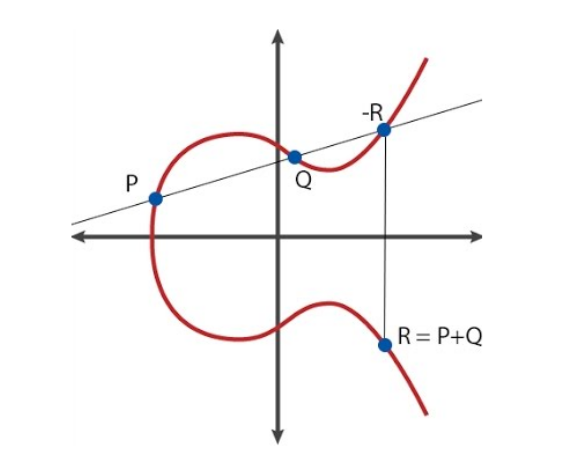
- Elliptic curve (E): y^2 = x^3 + ax + b
- Line (L): y=mx+n
The intersection points of (E) and (L) are the solutions to the equation below: \begin{align*} (mx+n)^2 &= x^3 + ax + b \newline m^2x^2 + 2mnx + n^2 &= x^3 + ax + b \newline 0 &= x^3 - m^2x^2 + (a-2mn)x + (b-n^2) \end{align*} According to Vieta’s Formulas x_P + x_Q + x_R = -(-m^2) / 1 = m^2
Assume 2 intersection points P, Q are already known, then the third intersection point -R, P(x_R, -y_R),
\begin{align*} x_R &= m^2 - x_P - x_Q \newline -y_R - y_P &= m(x_R - x_P) \newline \end{align*}
So the point R, P(x_R, y_R): \begin{align*} x_R &= m^2 - x_P - x_Q \newline y_R &= -m(x_R - x_P) - y_P \end{align*} If x_P \neq x_Q, m=\frac{y_P - y_Q}{x_P - x_Q} If x_P = x_Q \begin{align*} \frac{dy^2}{dx} &= \frac{d}{dx}(x^3+ax+b) \newline 2y\frac{dy}{dx} &= 3x^2 + a \newline \frac{dy}{dx} &= \frac{3x^2 + a}{2y} \newline & \implies \newline m & = \frac{3x_P^2+a}{2y_p} \end{align*}
Multiplication
nP = P + P + ... + P
Elliptic Curves over finite fields
In cryptography the finite field is usually a set of integers modulo p, where p is a prime number. It is denoted as GF(p) or \Bbb{F}_p, and char(\Bbb{F}_p) = p. Then an elliptic curve can be defined as: \{ (x,y) \in \Bbb{F}_p^2 \mid y^2 \equiv x^3 + ax + b \mod p, 4a^3 + 27b^2 \not\equiv 0 \mod 0 \} \cup \mathcal{O} where \mathcal{O} is still the point at \infty, a and b are two integers in \Bbb{F}_p, and char(\Bbb{F}_p)=p \neq 2,3
What is an elliptic curve cofactor?
https://crypto.stackexchange.com/questions/56344/what-is-an-elliptic-curve-cofactor
In cryptography, an elliptic curve is a group which has a given size n. We normally work in a subgroup of prime order r, where r divides n. The "cofactor" is h=n/r.
For every point P on the curve, the point hP is either the "point at infinity", or it has order r; i.e., when taking a point, multiplying it by the cofactor necessarily yields a point in the subgroup of prime order r.
SafeCurves: choosing safe curves for elliptic-curve cryptography https://safecurves.cr.yp.to/
Standard curve database
- https://github.com/J08nY/std-curves
- https://neuromancer.sk/std/
- P-384: https://neuromancer.sk/std/nist/P-384
What is an elliptic curve?
https://www.bilibili.com/video/BV1gN411o7un/?spm_id_from=333.337.search-card.all.click&vd_source=8d17b3ae547585ed3fea79027e6d20eb
Given a polynomial equation f(x_1, x_2, ..., x_r) = 0 with integer coefficients (i.e., a diophantine equation), we can ask three questions:
- Can we determine if there are rational or integral solutions?
- In the affirmative case, can we find such a solution?
- Can we describe all such solutions?
- (Hilbert's Tenth Problem over Z) Is there a Turing machine to decide if f=0 has solutions in Z (Davis, Matiyasevich Putnam, Robinson: No) .
Examples of diophantine equation:
- 9(x^2 + 7y^2)^2 - 7(u^2 + 7v^2)^2 = 2
Elliptic Curve Point Addition
https://www.rareskills.io/post/elliptic-curve-addition
Cryptography uses elliptic curves over finite fields, but elliptic curves are easier to conceptualize in a real cartesian plane.
the identity element (which is the only element that can be the inverse of itself)
Elliptic curve point multiplication
https://en.wikipedia.org/wiki/Elliptic_curve_point_multiplication
Constant time Montgomery ladder
The security of a cryptographic implementation is likely to face the threat of the so called timing attacks which exploits the data-dependent timing characteristics of the implementation.
Identity element https://en.wikipedia.org/wiki/Identity_element